Why a Backflow Assembly Bursts in a Texas Freeze, and What Actually Stops It
It only takes one bad night, not a whole winter, to crack a device that runs fine the other 364 days of the year.
September 2, 2026 · 3 min read
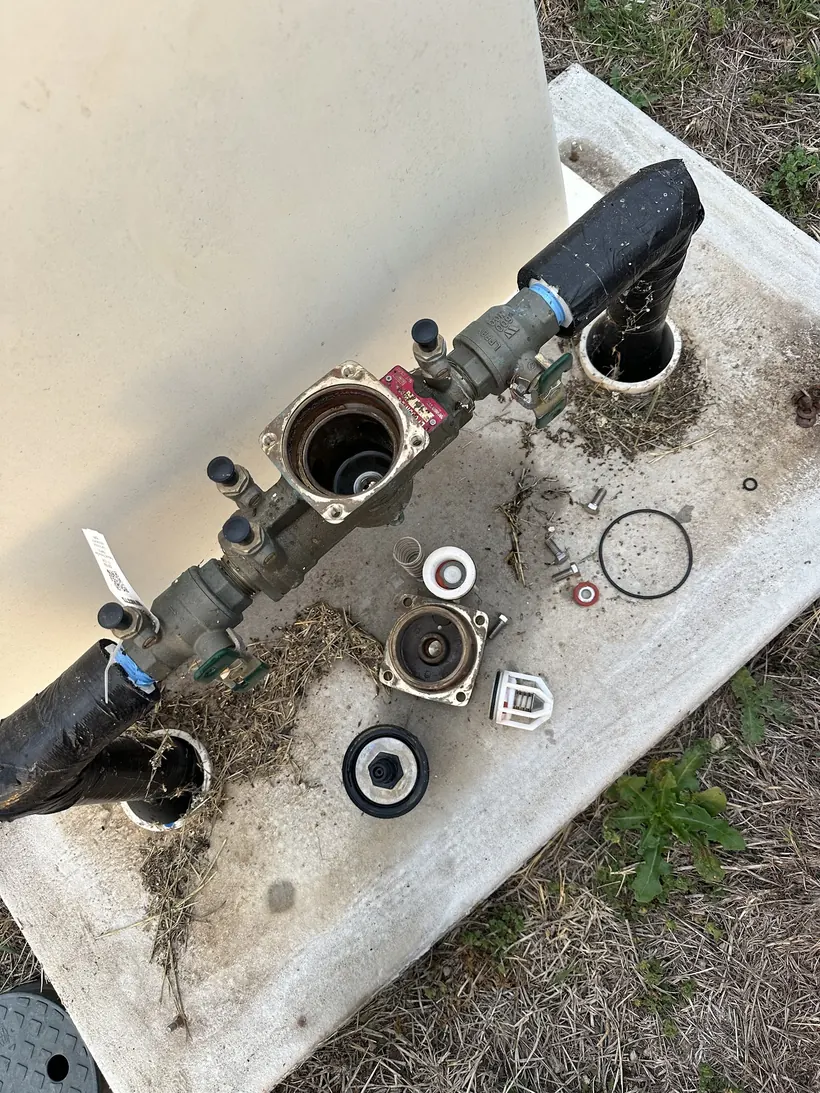
We get the same call every winter, usually the week the news starts showing frozen overpasses. Somebody's backflow preventer has split open overnight and there's a wet patch on the concrete pad where there shouldn't be one. It isn't a bad part. It's water doing exactly what water does when you give it the chance.
What's actually inside the device
A backflow preventer isn't a pipe with a valve stuck on it. It's a pair of spring-loaded check valves in a row, with a relief valve between them, and the whole point of the design is to trap water so it can't run backward into the drinking supply. That's the job. It also happens to be exactly what makes the assembly vulnerable in a freeze, because trapped water has nowhere to go when it expands.
Water gets roughly nine percent bigger turning into ice. A pipe that's open at both ends can sometimes get away with that. A sealed chamber with two closed check valves on either side can't. Something has to give, and it's usually the housing itself, not the valves.
Why it's outside in the first place
People assume we could just bury the whole thing and be done with it. Most assemblies can't be buried, because the relief valve has to be able to discharge to open air if it ever needs to dump pressure, and the assembly has to stay accessible for testing. That's not us being careless. It's the design doing its actual job. It just also means the thing sits exposed to whatever the weather does.
Why Central Texas gets hit harder than colder places
Places that freeze all winter build for it as a matter of course: insulated enclosures as standard, lines run below the frost line, assemblies indoors wherever code allows. Central Texas doesn't build that way, because most years it doesn't need to. Then a front drops the temperature twenty degrees in an afternoon, sits below freezing overnight, and by the time anyone's thinking about the backflow assembly it's already been exposed for six or eight hours. That's plenty. You don't need a week of hard freeze. You need one night and an assembly nobody wrapped.
What actually helps
- Insulate the assembly itself, not just the pipe leading up to it, with a wrap rated for outdoor use.
- Use a real insulated enclosure or cover over the whole unit. A towel or a trash bag traps almost no air and does almost nothing.
- Drain any hose bibbs and irrigation lines feeding off the system before a hard freeze. A full line under pressure is the part most likely to split first.
- Let a slow drip run from an attached fixture on the coldest nights, if your water provider and the manufacturer's guidance allow it. Moving water resists freezing longer than still water.
- Know where the shutoff is before you need it at eleven at night, not after.
None of that makes an assembly freeze-proof, and we're not going to tell you it does. Insulation buys time and lowers the odds. It doesn't rewrite what water does at thirty-two degrees. A hard enough freeze, long enough, beats almost anything you can buy at a hardware store.
The part most people skip
If your backflow assembly has been through a hard freeze, even one that looked fine the next morning, get it tested before you assume it's fine. A crack that's about to happen doesn't always announce itself with a puddle. It shows up first as a check valve that won't seat quite right, or a relief valve that's started weeping under pressure it used to hold without a problem. Backflow testing is routine work for us. A post-freeze test is a lot cheaper than finding out in July that the assembly never really recovered.
Cove Plumbing has been on Central Texas water systems since 1982, back when this same freeze pattern was already showing up every few winters. We install backflow devices, test them, and repair them, and we're licensed, insured, and regulated by the Texas State Board of Plumbing Examiners like every plumber working in this state. Call us before the next front rolls through if you can. We'll take it after, too. We just like the odds better before.
Cove Plumbing Inc — (254) 275-4275
Call (254) 275-4275More articles
What a Sewer Camera Actually Shows You, and When Jetting Beats a Roto Machine
The clog is never the whole story. The camera is how you find out what actually happened to the pipe.
Buying a House Near Fort Cavazos: The Water Heater Questions Worth Asking Before You Close
You've got thirty days and a moving truck already scheduled. These are the water heater questions worth spending ten minutes on anyway.